

How Does the Binding Process Work in School Notebook and Book Production?
5 Mayıs 2026
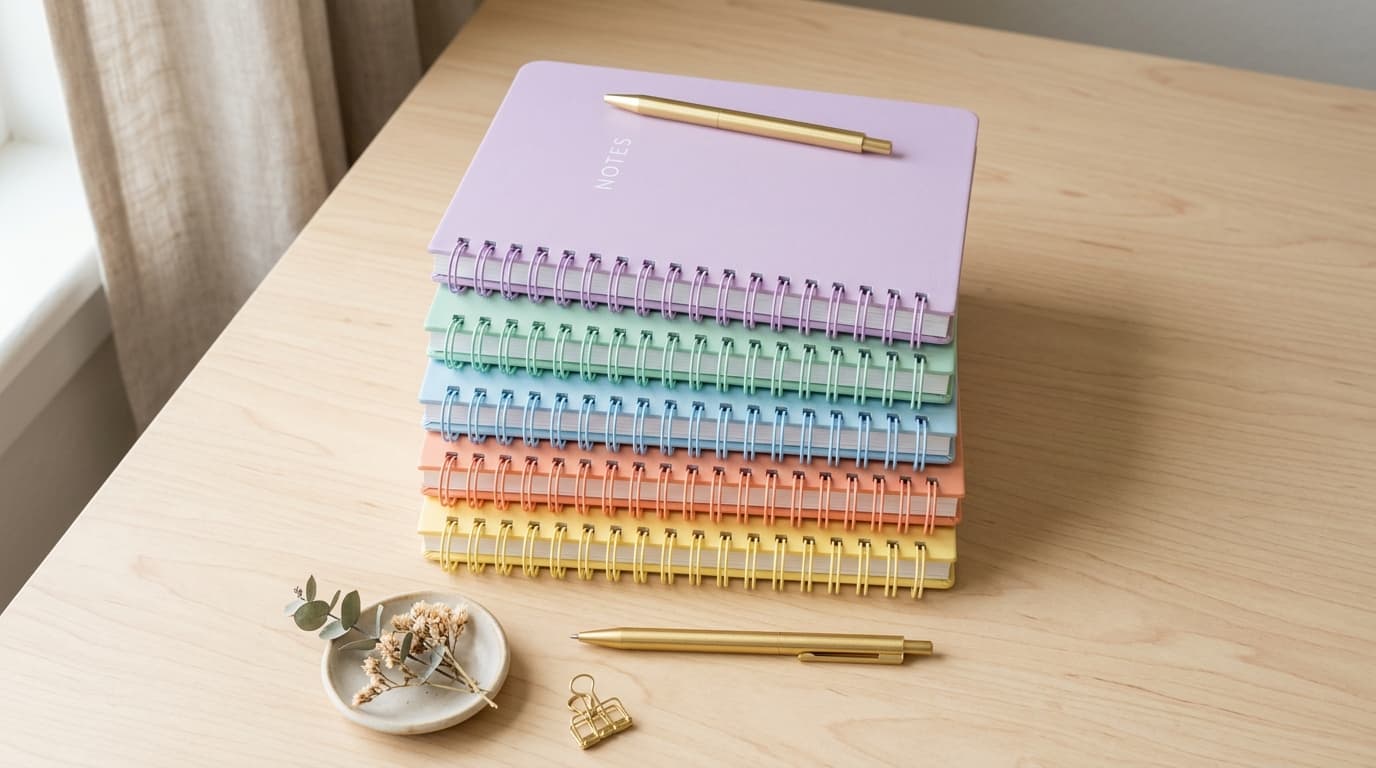
Millions of notebooks and school books are produced before each education season in Türkiye.The biggest challenge for printing houses and notebook manufacturers in this busy period is to produce high volumes and consistent quality in a short time.In this article, we explain how the binding process works in school notebook and book production and ways to make this process efficient.
Features of School Season Production
School notebook production has a different dynamic than other binding works.Demand increases significantly at the end of the summer months and the beginning of the school year;This requires manufacturers to produce very high volumes in a short period of time.This density makes both capacity planning and machine selection critical.
Steps of the Binding Process
1. Paper Preparation and Collation
The pages that make up the notebook content are first collated in the correct order and subjected to size/thickness control.A small mistake at this stage can affect all subsequent steps.
2. Drilling
The collated stacks of pages are punched according to the binding method.In high-volume notebook production, automatic hole punching machines such as the AP400A and AP400C speed up this step at up to 100 strokes per minute.
3. Spiral or Wire Feed
A spiral or wire of suitable diameter and type is fed to the punched pages.While plastic spiral, which offers economical and colorful options, is generally preferred in school notebooks, wire binding can be used in higher quality and durable notebooks.
4. Binding
The fed spiral or wire is shaped and closed by automatic machines.Machines like the AB36 can complete this step at speeds of up to 2100 books per hour, and machines like the AB42C can complete this step at speeds of up to 3000 books per hour.
5. Quality Control and Packaging
Bound notebooks are checked for page alignment, spiral/wire fit and general appearance.It is then packaged for shipping.
Capacity Planning in High Volume Production
Capacity planning before the school season is the most effective way to prevent order loss.Elements to consider in this planning:
- Seasonal demand data from previous years
- Whether your current machine capacity meets seasonal demand
- Need for additional shifts or new machinery investment
- Raw material (paper, spiral, wire) supply continuity
Lack of capacity, especially during periods of high time pressure such as the school season, can lead to both delays in existing orders and loss of customers for the next year.
Differentiating Needs in Book Binding
School books generally contain more pages than notebooks and require more durable binding.In this type of work, inline punching and binding lines such as the PB-2000 meet both volume and durability needs with a production speed of up to 3000 books per hour.The biggest advantage of inline lines is that the punching and binding steps are integrated into a single continuous line;This reduces operator intervention and increases production speed.
Suggestions for Cost Efficiency
- Prevent unexpected downtime by completing machine maintenance before the season
- Reduce setup time by using preset machine profiles for standard formats
- Reduce the need for frequent replacement by choosing high loop count wire spiral coils
- Prevent defective products from being detected late by integrating quality control points into the production line
Functional Details in School Notebook Design
Functional details are as important as aesthetics in the design of school notebooks: the pages can be easily removed without tearing (perforation), the cover is resistant to daily bag use, and the binding can withstand long periods of being left open (a notebook left open on the table during class).These functional requirements directly affect the binding method and material quality you choose.For example, the constant mechanical stress on the binding area of a notebook that is constantly open may cause a low-quality spiral to loosen over time.
Anticipating such functional requirements at the design stage and choosing the appropriate binding quality ensures that your product remains durable under real use conditions.
Timing of Material Supply in School Notebook Production
The supply of materials such as paper, cardboard and wire/spiral used in school notebook production should generally be done in a certain order before the season.Paper generally has the longest lead time and therefore needs to be ordered at the earliest;Wire spiral and other consumables can be supplied in a relatively shorter time.Planning this supply chain in the correct order ensures that all ingredients are ready simultaneously when the season begins.
Capacity Assessment Outside the School Season
For businesses focusing on school notebook production, how to utilize machine capacity during off-season periods is a separate strategic issue.While some manufacturers turn to corporate agendas or promotional products during these periods, some allocate some of their capacity to contract manufacturing services.Regardless of which strategy is followed, active and efficient use of the machinery throughout the year is an important factor that shortens the return on investment.
The Importance of Standardization in Mass School Orders
When a school orders notebooks in the same format for all its students, consistency across products becomes extremely critical.In such bulk orders, ensuring there is no difference in binding quality between the first notebook produced and the last notebook produced is key to maintaining the trust of the school and parents.To ensure this consistency, it is necessary to perform quality checks at regular intervals throughout the production of a large bulk order and ensure that machine settings remain constant throughout the batch.
Understanding Parent and School Expectations
In school notebook production, the end user is usually children, but it is the parents and sometimes the schools directly who make the purchasing decision.The expectations of these two stakeholders may differ: parents often look for durability and a reasonable appearance, while schools value standardized format and consistent quality.Designing your production process to meet both of these expectations provides a competitive advantage in both direct consumer sales and bulk school orders.
Post-Season Evaluation
An evaluation meeting after the season ends allows you to learn valuable lessons for the following year.In this evaluation, it is useful to seek answers to the following questions: at what points there was a capacity shortage, in which formats unexpected quality problems arose, at what points in the supply chain there were delays, and which issues came to the fore in customer feedback.This type of systematic evaluation prevents the same mistakes from being repeated year after year and gradually matures your pre-season preparation process.
Putting these evaluations in writing and reviewing them before the start of the next season allows your team to remember last year's lessons and repeat the same preparation process more consciously.
The Importance of Acting Early in Supply Chain Planning
School season production is not just limited to machine capacity;Raw materials such as paper, cover material and wire/spiral must also be supplied on time and in sufficient quantities.By sharing your production plan with your suppliers before the season, guaranteeing the amount of raw materials you will need in advance will prevent supply problems that may occur in the middle of the season.
Especially considering the fluctuations in paper prices and supply times, ordering early can provide advantages in terms of both price and delivery.Experienced producers usually start preparations for the next season immediately after the end of the previous season.
Maintaining the Balance Between Quality and Speed
During busy periods such as the school season, it may be tempting to compromise on quality standards under pressure for speed;but this can damage your brand reputation in the long run.When faced with a low-quality notebook, parents and schools remember this experience and may turn to a different supplier next season.Therefore, while increasing capacity, strengthening your quality control processes at the same rate is critical for long-term customer loyalty.
Frequently Asked Questions
Which binding method is more common in school notebook production?Plastic spiral binding is the most widely used method in school notebook production because it offers economical and colorful options.
When should capacity planning be done for the school season?Ideally, capacity needs should be determined by analyzing previous year data a few months before the season starts and investment should be planned if necessary.
Which machines are recommended for high volume notebook production?Fully automatic wire binding machines such as AB36 and AB42C speed up high-volume notebook production by reducing labor costs.
What is the advantage of inline lines in book binding?Inline lines integrate the punching and binding steps into one continuous process, reducing operator intervention and significantly increasing production speed.
What is the most common problem in school season production?Lack of capacity and resulting delivery delays are among the most common problems in school season production.
Get Ready for the Training Season
As SpiralMakineleri.com, we support your pre-season capacity planning with H&Y machines that provide high volume and consistent quality in school notebook and book production.
Contact our expert teamand enter the training season by strengthening your capacity.