

Binding Machine Types: Difference Between Manual, Semi-Automatic and Fully Automatic
24 Haziran 2026
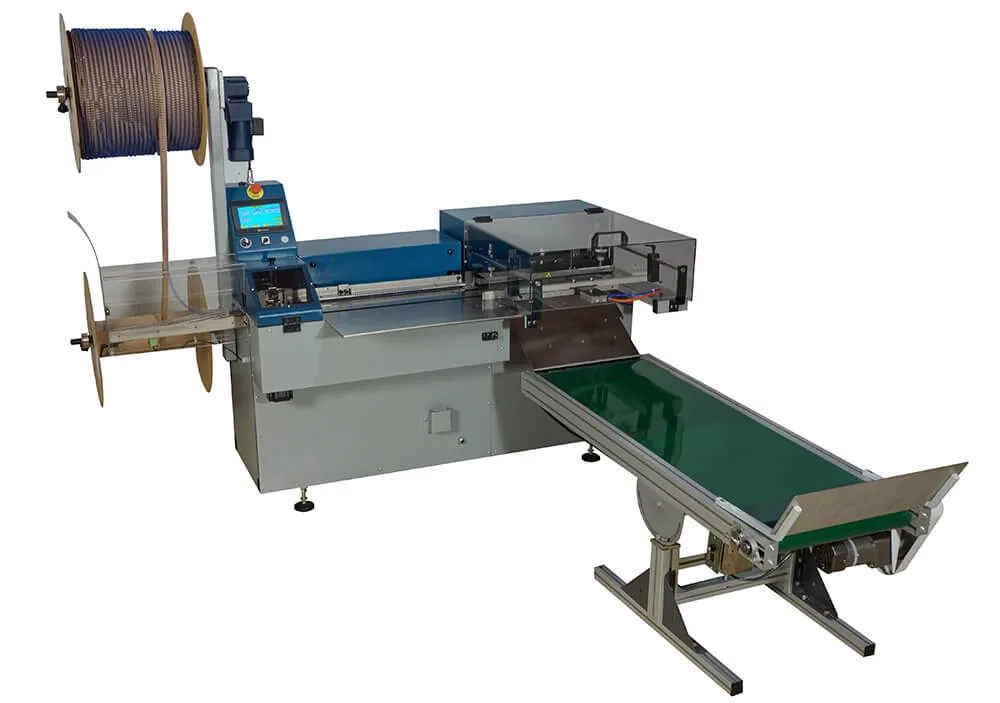
When you start researching binding machines, you will come across three main categories: manual, semi-automatic and fully automatic.The difference between them is not just the price;It is a choice that has a direct impact on your business volume, team structure and growth targets.In this article, we examine each category in detail and help you determine which level is right for your business.
Manual Binding Machines
It is the simplest and lowest investment option.Punching and binding steps are done manually by the operator.It's a logical starting point for small-scale stationers, offices or businesses with occasional binding needs.
Advantages:- Low initial cost - Simple use, short learning period - Sufficient for small volume jobs
Disadvantages:- Operator fatigue increases as daily work volume increases - Higher margin of error and product inconsistency - There is a loss of time in high circulation jobs
Semi-Automatic Binding Machines
In semi-automatic machines, some of the punching and binding processes are motorized;The operator still plays an active role in the process, but the physical effort and error rate are greatly reduced.For example, a semi-automatic binding machine like the CB-420 can run up to 1100 books per hour and supports a wide wire gauge.
Advantages:- Significant speed increase compared to manual machines - More consistent and smooth results - Lower investment cost than full automation
Who is it suitable for:Semi-automatic machines are ideal for medium-sized print shops and binding workshops looking for a balanced middle ground between the slowness of manual binding and the cost of full automation.
Fully Automatic Binding Machines
In fully automatic machines, all steps of wire feeding, cutting, shaping and binding are carried out by the machine.The operator's job is usually reduced to feeding and quality control.Machines like the AB42C can produce up to 3000 books per hour, while models like the AB36 run at speeds of up to 2100 books per hour.
Advantages:- Very high production speed and capacity - Significant decrease in labor costs - Mass production with consistent, standard quality - Uninterrupted working opportunity
Who is it suitable for:It is one of the most effective ways to reduce labor costs and shorten delivery times for businesses that produce high-circulation agendas, notebooks and calendars.
Comparison of Three Categories
|Feature |Manual |Semi Automatic |Fully Automatic | |---|---|---|---| |Investment level |Low |Medium |High | |Production rate |Low |Medium (e.g. 1100 books/hour) |High (e.g. 3000 books/hour) | |Operator dependency |High |Medium |Low | |Ideal business scale |Small |Medium |Large/mass production | |Consistency |Variable |Good |Very high |
Which Level is Right for You?
It is useful to ask yourself these questions when making a decision:
- What is your average daily/weekly binding volume?
- Do you experience seasonal demand fluctuations (such as calendar season)?
- What is the operator capacity and experience of your current team?
- How do you expect your production volume to grow in the next 2-3 years?
- How much of the total cost do labor costs make up?
For a small workshop, switching to full automation immediately may be an unnecessary investment;But for a printing house with high circulation and regular orders, staying at the manual or semi-automatic level may cause you to fall behind your competitors.Especially when demand explodes during the calendar and agenda season, lack of capacity can lead to serious order losses.
Things to Consider During the Transition Process
When moving from one category to another, you must take into account not only machine cost, but also operator training, maintenance requirements, and integration time into your existing workflow.Transitioning to a fully automatic line may require a learning curve that can generally be achieved within 6-12 months;Planning this process from the beginning makes the transition much smoother.
An In-Depth Look at the Impact of Three Categories on Total Operating Cost
When choosing a binding machine category, calculating not just the purchase cost but how much that category will cost your business in total over the years is the only way to truly make the right decision.With a manual machine, there is a high labor cost versus a low purchasing cost;Each additional operator means salary, insurance and training costs.In a semi-automatic machine, this balance shifts a little more to the middle: fewer operators are needed, but machine maintenance and consumable consumption increases slightly.In a fully automatic machine, labor costs are almost minimized, while energy consumption and technical service needs are maximized.
Comparing these three cost structures over a five-year period will clarify which category is truly more economical for your business.Many businesses make a decision by looking only at the initial investment cost without making this calculation, and then realize that a higher level of automation is actually more economical in the long run.
Transition Signals Between Machine Categories
Recognizing the right time to move from each category to the next is a skill learned through trial and error for most businesses.But some concrete signals can help you recognize this transition point in advance.The signal to switch from manual to semi-automatic usually appears as follows: your operators regularly work overtime, you are hesitant to accept orders, or your error rate exceeds the acceptable level.The signal to switch from semi-automatic to fully automatic usually manifests itself as follows: your existing semi-automatic machine is running almost constantly, you need to add additional shifts, or you have to reject large corporate orders due to lack of capacity.
You can create a simple dashboard to track these signals on a regular basis: tracking metrics like weekly overtime hours, number of rejected orders, and error/return rate will allow you to give an answer to the question “when should I invest” based on data, not feelings.
Hybrid Approach: Using Multiple Levels Together
For some businesses, the most efficient solution is to use different levels together rather than sticking to a single level of automation.For example, using a fully automatic machine for high-volume standard products, while keeping a semi-automatic or manual machine for low-volume special orders provides both efficiency and flexibility.This hybrid approach is a smart strategy, especially for businesses with a diverse product line.
In this way, you will not have to reject special and low quantity requests while operating your fully automatic line at maximum efficiency by constantly dividing it into high volume standard jobs.Many successful printing houses evolve towards this type of layered machinery as they grow.
Invisible Costs Affecting Investment Decisions
When choosing a machine level, not only the purchase price but also the specific operating costs of each level should be taken into consideration.The biggest hidden cost in manual machines is labor: as the number of operators increases, so does the social security, training and management burden.While maintenance and consumables consumption become more prominent in semi-automatic machines, energy consumption and technical service needs become more decisive in fully automatic machines.
Evaluating these three levels not only with the question "how much will I buy it for?" but also with the question "how much will I spend in total with this machine in a year?" will allow you to make a much healthier decision.Especially in regions with high labor costs, the payback period for switching to full automation may be much shorter than expected.
Operator Experience and Machine Level Relationship
Another important factor is the experience level of your current team.Manual and semi-automatic machines are more dependent on the skill and attention of the operator;So if you have an experienced team you can achieve high quality even at these levels.In fully automatic machines, operator experience is less decisive, as the machine guarantees a largely standard result.For businesses that are newly established or experience frequent staff changes, this can be an added benefit of full automation.
Frequently Asked Questions
What is the main difference between semi-automatic and fully automatic binding machine?In semi-automatic machines, the operator plays an active role in the process, while in fully automatic machines, all wire feeding, cutting and binding steps are carried out by the machine.
Which type of binding machine is enough for a small stationery?For low and irregular volume jobs, manual or entry-level office machines are usually sufficient.
When does it make sense to switch to a fully automatic binding machine?Full automation should be considered when your production volume reaches regularly high levels and labor costs begin to constitute a significant portion of your total cost.
How fast are semi-automatic machines?For example, a semi-automatic binding machine such as the CB-420 can process up to 1100 books per hour.
How fast are fully automatic machines?Fully automatic machines such as the AB42C can reach a production speed of up to 3000 books per hour, and models such as the AB36 can reach a production speed of up to 2100 books per hour.
We Are Here to Find the Right Scale
As SpiralMakineleri.com, we offer a wide range of H&Y machines, from office type to fully automatic production lines.We can help you decide which level is best for your business.
Check out our machinesor tell us your needs and we will prepare a special proposal for you:Contact us.